
IRS Filing Season Statistics 2026: What the Numbers Mean for the Tax Industry and the U.S. Economy


Every tax season, the IRS releases weekly filing statistics that provide a real-time snapshot of taxpayer behavior, refund activity, and filing trends across the United States. The data for the week ending February 27, 2026 reveals several important shifts that impact tax professionals, tax preparation businesses, and the broader economy.
Understanding these trends can help tax preparers adjust their business strategies and anticipate economic activity driven by tax refunds.
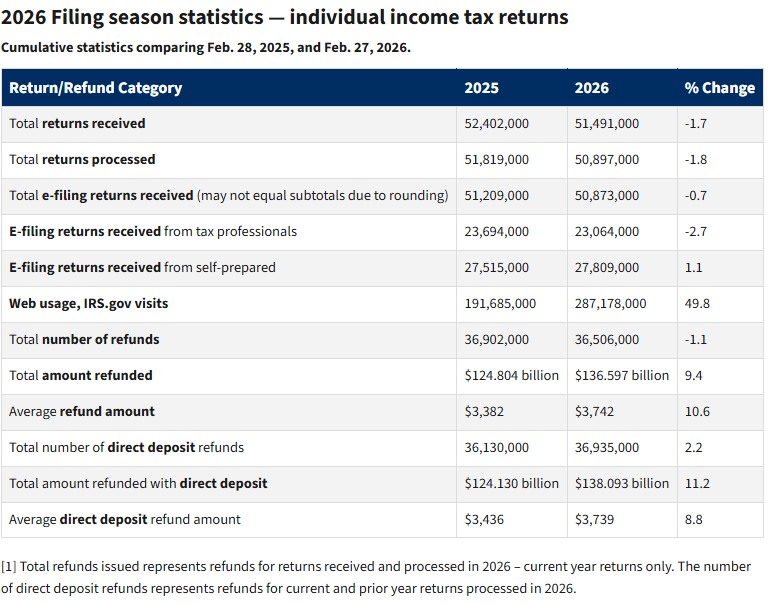
Key IRS Filing Season Statistics (2026 vs 2025)
Based on IRS weekly filing reports, the early part of the 2026 tax filing season shows fewer returns filed but larger refunds compared to the same time period in 2025.
Filing Activity
- Total returns received: ~41.9 million (2026) vs ~42.7 million (2025) → -1.9%
- Total returns processed: ~41.3 million (2026) vs ~42.4 million (2025) → -2.4%
E-Filing Trends
- Total e-filed returns: ~41.4 million → -1.2%
- Returns filed by tax professionals: ~17.8 million → -2.9%
- Self-prepared returns: ~23.6 million → +0.1% (IRS)
Early Season Trends
During the first weeks of the season, returns filed were down even more sharply:
- Returns received early in the season fell 5.2% compared to 2025. (IRS)
These numbers reveal important shifts in taxpayer behavior and industry dynamics.
Why Fewer People Are Filing Early in 2026
Several factors appear to be slowing early filings this year.
1. Taxpayers Waiting for Documents
Many taxpayers are delaying filing while waiting for:
- Late 1099 forms
- Brokerage statements
- Health insurance Form 1095-A
- Investment income statements
When markets are volatile, tax forms often arrive later.
2. New Tax Law Changes
The One Big Beautiful Bill Act introduced several new deductions, including:
- Overtime income deduction
- Tax benefits for seniors
- Additional deductions for certain purchases
Because these rules are new, taxpayers and preparers may be waiting for clearer guidance before filing.
3. Shift Toward DIY Filing
Self-prepared returns slightly increased while returns filed by professionals declined early in the season. (IRS)
This trend reflects:
- More online tax software usage
- Growth of AI-assisted tax filing tools
- Increased digital literacy among taxpayers
However, many complex returns are still filed closer to the deadline.
The Big Story: Tax Refunds Are Larger in 2026
Even though filings are down slightly, refunds are significantly larger this year.
Early data shows:
- Average refunds roughly 10% higher than last year
- Some taxpayers receiving about $775 more due to new deductions. (MarketWatch)
For many households, tax refunds represent the largest cash infusion of the year.
Economic Impact of Higher Tax Refunds
Tax refunds play a surprisingly large role in the U.S. economy.
1. Consumer Spending Boost
Many taxpayers use refunds for:
- Paying credit card debt
- Major purchases
- Rent or mortgage payments
- Car repairs
- Travel
When refunds increase, consumer spending typically rises in March and April.
Some economists estimate hundreds of billions of dollars in refunds are issued annually, creating a seasonal economic stimulus.
2. Debt Reduction
A large percentage of taxpayers use refunds to:
- Pay down high-interest debt
- Catch up on bills
- Build emergency savings
This improves household financial stability.
3. Small Business Cash Flow
Refund season also benefits small businesses such as:
- Auto dealerships
- Electronics retailers
- Furniture stores
- Travel companies
For many industries, refund season is comparable to a mini economic stimulus.
What This Means for Tax Professionals
For tax preparers and tax office owners, the IRS data signals several important trends.
1. Filing Season Is Becoming More Back-Loaded
With fewer early filings, many tax offices may experience:
- A slower January and early February
- A much busier March and April
Tax firms should plan staffing accordingly.
2. Opportunity for Tax Advisory Services
The new deductions and changing tax rules create demand for:
- Tax planning
- Refund optimization
- Small business advisory
- Entity structure planning
Tax professionals who offer advisory services rather than just compliance will benefit most.
3. Technology Is Changing the Industry
The increase in self-prepared returns highlights growing competition from:
- DIY tax software
- AI tax assistants
- automated filing platforms
Tax professionals must differentiate themselves through:
- expertise
- planning strategies
- audit protection
- business advisory services.
IRS Processing Trends
The IRS expects about 164 million tax returns to be filed for the 2025 tax year before the April deadline. (IRS)
Despite fewer early filings, the system is still processing millions of returns weekly.
However, potential challenges include:
- IRS staffing reductions
- increased identity verification checks
- delays for paper filings
These factors reinforce the importance of electronic filing and accurate submissions.
The Big Picture: What the 2026 Filing Season Tells Us
The IRS statistics reveal three key trends shaping the tax industry:
1. Filing patterns are shifting
Taxpayers are filing later in the season compared to previous years.
2. Refunds are increasing
Larger refunds will likely boost consumer spending in early spring.
3. The tax industry is evolving
Technology and automation are pushing tax professionals to provide higher-value advisory services.
Final Thoughts
The IRS filing season statistics are more than just numbers—they are a real-time economic indicator.
The early 2026 data shows:
- Slightly fewer filings
- Larger refunds
- Shifting taxpayer behavior
For the tax industry, this means greater opportunity for planning, advisory services, and strategic client relationships.
Tax professionals who understand these trends will be better positioned to grow their firms and serve clients more effectively in the evolving tax landscape.