
Why Your Tax Refund Stayed Almost the Same Even Though Your Income Dropped

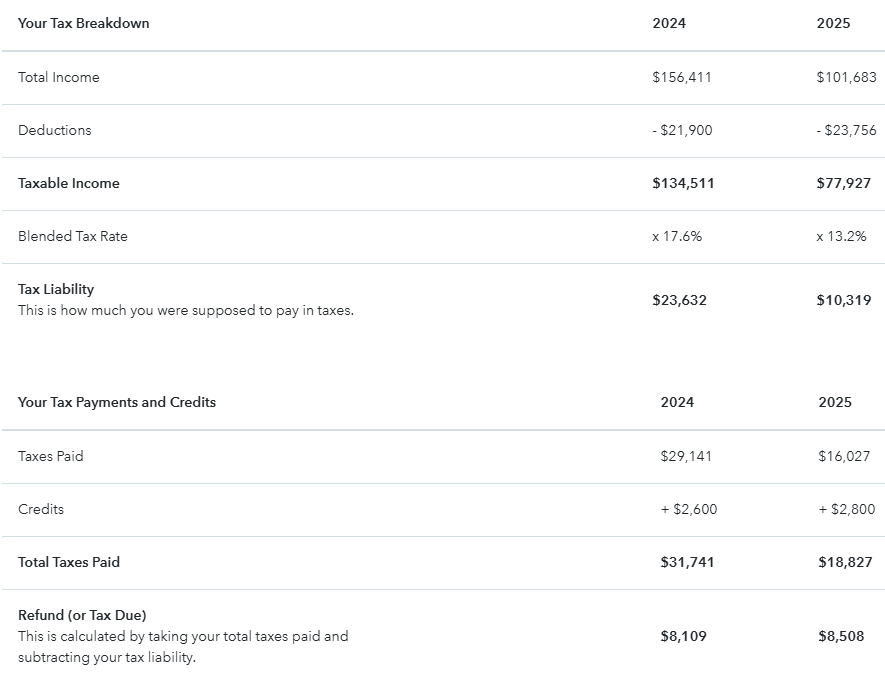
Many taxpayers are surprised when they compare two tax years and see a situation like this:
- Income dropped significantly
- Tax liability decreased
- But the tax refund stayed almost the same
At first glance, it may seem confusing. However, when you understand how tax withholding, deductions, and credits interact, the numbers start to make sense.
Let’s break down this tax situation step-by-step.
Income Decreased Between the Two Years
The first big change is the drop in total income.
| Year | Total Income |
|---|---|
| 2024 | $156,411 |
| 2025 | $101,683 |
This represents a decrease of:
$54,728 less income
Lower income generally leads to lower taxes, which we can see reflected in the tax liability.
Taxable Income Also Dropped
After deductions are applied, the income that is actually taxed is called taxable income.
| Year | Taxable Income |
|---|---|
| 2024 | $134,511 |
| 2025 | $77,927 |
That’s a decrease of:
$56,584 less taxable income
Because the U.S. tax system is progressive, lower income often moves taxpayers into lower tax brackets.
Your Tax Rate Went Down
Your blended tax rate (effective tax rate) also decreased.
| Year | Blended Tax Rate |
|---|---|
| 2024 | 17.6% |
| 2025 | 13.2% |
This means that in 2025 you paid a smaller percentage of your income in taxes.
Your Tax Liability Was Much Lower
Your tax liability is the amount you actually owed in taxes for the year.
| Year | Tax Liability |
|---|---|
| 2024 | $23,632 |
| 2025 | $10,319 |
That is a reduction of:
$13,313 less tax owed
This is exactly what we would expect when income drops significantly.
Taxes Paid Also Dropped
However, something important also happened:
You paid less tax during the year.
| Year | Taxes Paid |
|---|---|
| 2024 | $29,141 |
| 2025 | $16,027 |
That’s about:
$13,114 less tax withheld or paid
This usually happens when:
- Your employer adjusts withholding
- Your income drops
- Estimated payments are reduced
Credits Increased Slightly
Tax credits also increased slightly.
| Year | Credits |
|---|---|
| 2024 | $2,600 |
| 2025 | $2,800 |
Credits directly reduce taxes owed, which helped lower the final tax bill.
Why the Refund Stayed Similar
Your refund is calculated as:
Total Taxes Paid – Tax Liability
Let’s compare.
2024
Total Taxes Paid:
$31,741
Tax Liability:
$23,632
Refund:
$8,109
2025
Total Taxes Paid:
$18,827
Tax Liability:
$10,319
Refund:
$8,508
Even though income dropped dramatically, the refund stayed similar because:
You also paid less tax during the year.
In other words:
- Lower income → lower tax bill
- But also → lower tax withholding
These two changes balanced each other out.
A Simple Way to Understand It
Think of taxes like a deposit account with the IRS.
Throughout the year:
- Your employer deposits money (withholding)
- You accumulate a tax bill
At tax filing time:
- If you deposited too much, you get a refund
- If you deposited too little, you owe money
In this case:
- The tax bill dropped by about $13K
- The taxes paid also dropped by about $13K
So the refund stayed almost the same.
Is This a Good Situation?
Yes — financially this is actually neutral to positive.
You avoided overpaying taxes too much during the year, while still receiving a refund.
However, many financial advisors recommend smaller refunds and more money in your paycheck throughout the year instead of giving the IRS an interest-free loan.
Tax Planning Opportunities
A situation like this can open the door to tax planning strategies such as:
- Adjusting W-4 withholding
- Increasing retirement contributions
- Planning for tax credits
- Using tax-efficient investment strategies
These strategies can help reduce taxes even further in future years.
Final Thoughts
This tax comparison shows how several moving pieces affect your final refund:
- Total income
- Deductions
- Tax rates
- Credits
- Taxes withheld during the year
Even though income fell by more than $50,000, the refund remained similar because both the tax liability and the taxes paid dropped by nearly the same amount.
Understanding this relationship helps taxpayers avoid confusion and make better financial decisions during tax season.




Responses