
Magnetic launches AI tax agent with accuracy guarantee as firms face talent crunch

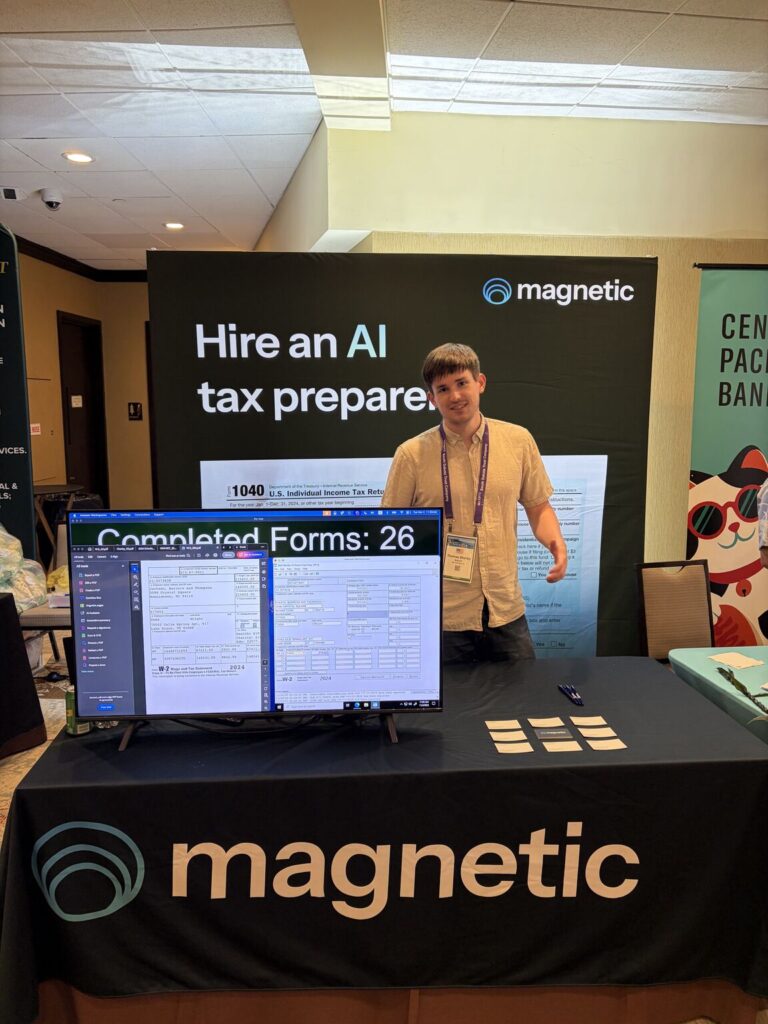
Why it matters: The tax profession is facing a severe labor shortage just as complexity continues to rise. San Francisco-based startup Magnetic believes AI agents—not just OCR—may become the next workforce for CPA firms.
The big picture: Tax firms across the U.S. are struggling to hire preparers while veteran accountants retire and fewer graduates enter the profession. The result: overwhelmed firms, 80-hour work weeks, and growing client waitlists. Magnetic is betting that AI can fill the gap.
This week, Magnetic announced a major product release: an end-to-end AI tax agent designed to automate nearly every aspect of 1040 return preparation, including contextual tax analysis and document interpretation. The company paired the launch with an unusual promise—an unconditional accuracy guarantee.
How it works
Unlike traditional OCR systems that simply extract fields from forms, Magnetic says its platform reasons across the entire tax return.
The workflow begins when a tax firm exports a blank or rolled-forward client file from tax software such as UltraTax, CCH Axcess, Lacerte, Drake, or ProConnect. Preparers then upload source documents in virtually any format: PDFs, Excel spreadsheets, Word documents, scanned images, smartphone photos, or even handwritten notes.
The AI then:
- Organizes and categorizes documents
- Detects duplicates and anomalies
- Reads handwritten annotations and margin notes
- Creates bookmarked workpapers
- Builds an internal representation of the tax return
- Writes directly into tax software using operating-system automation
The system employs an “orchestrator” agent that delegates tasks to specialist sub-agents dedicated to specific schedules and forms, such as Schedule E, Form 1098, and K-1 processing.
Human review remains central
Despite the automation, Magnetic still relies on human oversight.
Every return is reviewed by a U.S.-based Enrolled Agent or CPA before delivery. Reviewers receive confidence scores and AI-generated notes that help prioritize areas requiring attention. According to the company, most firms spend only 20 to 30 minutes performing a final review before delivering returns to clients.
The final output includes:
- A completed tax software file
- A bookmarked workpaper PDF
- A notes file identifying missing information or follow-up items
By the numbers
- More than 80 million U.S. individual tax returns are prepared by professionals annually.
- CPA firms collectively spend roughly $2 billion annually on outsourcing and data-entry services.
- Magnetic says its proprietary vision model improved field-level accuracy from approximately 50% to 89%, approaching human-verified services at 92%.
- The company reports customer growth exceeding 30% month-over-month since launch.
The accuracy guarantee
Perhaps the most notable announcement is Magnetic’s guarantee.
If a return prepared through Magnetic contains an error resulting in a tax liability change of $10 or more, the company refunds the entire preparation fee. During the Spring 2026 tax season, Magnetic says only 3% of customers invoked the guarantee.
Co-founder Thomas Shelly described the guarantee as a mechanism for aligning incentives and accelerating product improvement through feedback loops. The company argues that return-level accuracy—not merely field-level extraction—is the metric that matters most to tax firms.
Security and compliance
Magnetic says it complies with IRC Section 7216, keeps all customer data within U.S.-based infrastructure, and does not train AI models using customer data. Human reviewers are also U.S.-based EAs and CPAs.
Currently, the platform supports only Form 1040 returns but handles many complex scenarios, including:
- Schedule A itemized deductions
- Schedule C businesses
- Schedule D investments
- Schedule E rental properties
- K-1 income
- Multistate returns
- Basis tracking
Business returns are not yet supported.
Between the lines
The launch signals a broader shift occurring across tax technology.
For decades, tax automation focused primarily on OCR and data extraction. Magnetic’s approach suggests the next frontier may be “agentic AI”—systems capable of interpreting tax law, reasoning across documents, and executing workflows inside legacy software without requiring APIs.
If successful, such systems could fundamentally alter the economics of tax preparation by allowing firms to scale without proportionally increasing headcount.
What to watch
The biggest question for the profession is no longer whether AI will enter tax preparation—but how quickly firms will adopt it.
As staffing shortages deepen and client demand continues to grow, AI agents like Magnetic may become less of a competitive advantage and more of a necessity for firms seeking to survive future tax seasons.








Responses